Global Health Security
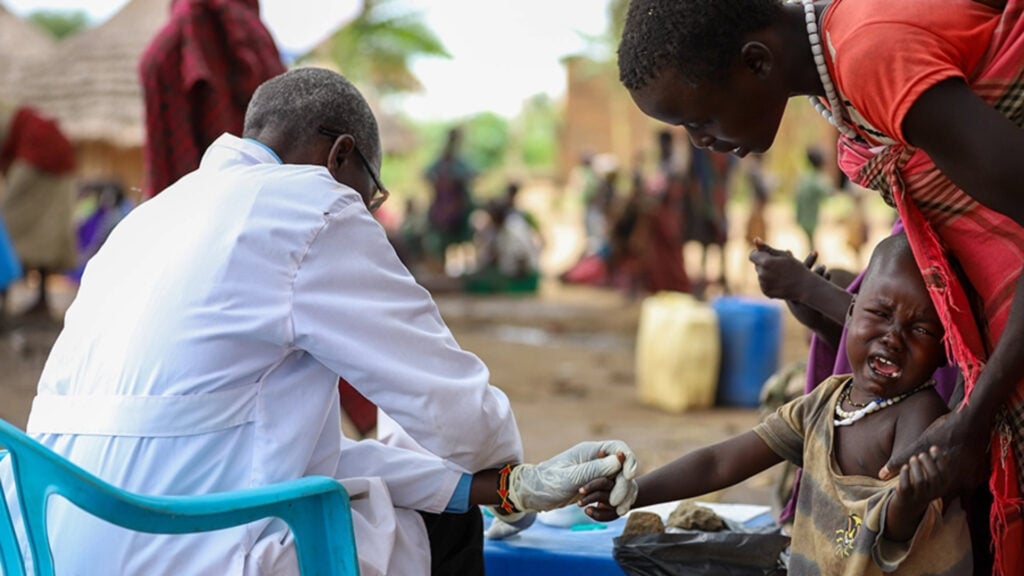
A child is vaccinated during a postpartum hemorrhage awareness and integrated outreach campaign in Napeikar Village, Uganda. Photo credit: URC
Global Health Security
URC is a recognized global leader in building resilient and effective health systems that prevent, detect, and respond to infectious diseases, including TB, malaria, HIV/AIDS, Zika, Ebola, Avian Influenza, and Mpox. Working in more than 110 countries, URC’s global health security initiatives have strengthened national policies and strategies, institutionalized evidence-based approaches to improve health care quality from infection prevention and control (IPC) to immunization services, bolstered risk communication and laboratory and surveillance systems, and improved health worker competencies and readiness.
We embrace the 7-1-7 target to provide a clear performance benchmark for accountability: detect within 7 days, notify within 1 day, launch a response within 7 days.
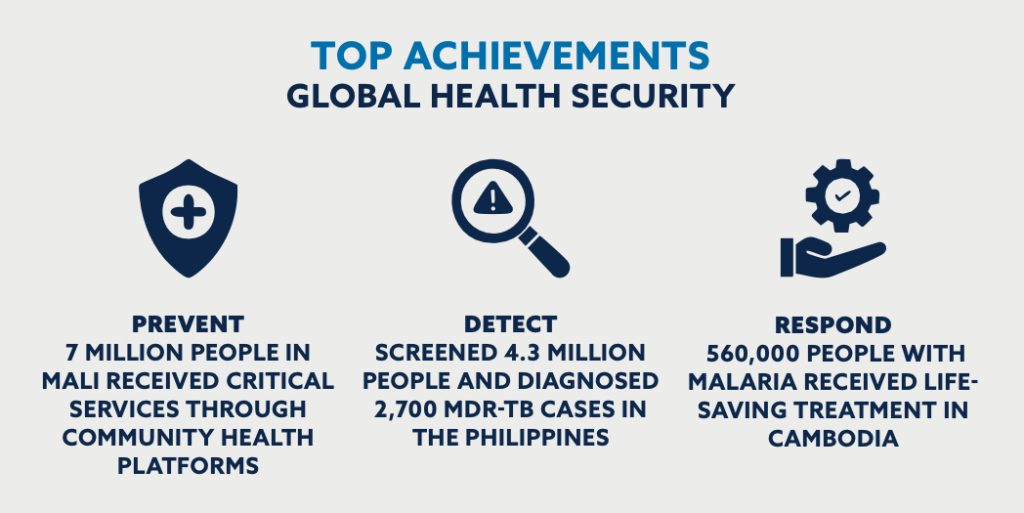
This expertise aligns with the America First Global Health Strategy, increasing capacity at local, national, regional, and global levels to:
- Prevent infectious disease outbreaks;
- Detect threats early and accurately; and
- Respond to infectious diseases rapidly and effectively.
The patient experience is paramount. URC leverages 40 years of experience supporting efforts in strengthening delivery of quality health services and providing continuous quality improvement to build stability in communities and resilience in systems.
Engagement throughout the health system and from civil society, patient organizations, the private sector, community stakeholders, and sectors beyond health is critical to success.
This unwavering commitment to strengthening access to and quality of health care services has driven URC for decades across the globe, fighting infectious diseases, transforming health systems, and improving health outcomes.
Impact
Prevent
URC helps countries plan and execute immunization campaigns; supports safe handling, transport, and distribution of vaccines to health facilities; and provides training and tools for data capture and reporting. Success stretches from Mongolia—where URC designed and led a pilot intervention to introduce the multidose HPV vaccine in schools—to the Philippines where URC supported the Department of Health’s national door-to-door measles, mumps, and rubella campaign with risk communication and advocacy efforts. Working with the Ministry of Health in Uganda, URC supported the East-Central region to address COVID-19: 7,200 health workers were trained and 15,000 volunteers helped disseminate life-saving information.
Detect
URC’s extensive experience in lab strengthening includes work with USAID, the U.S. Centers for Disease Control and Prevention (CDC), and U.S. Department of Defense in Sub-Saharan Africa, Latin America, Asia, and the Middle East. Technical assistance supported 38 TB and HIV labs in El Salvador, Guatemala, Honduras, Nicaragua, and Panama under the Central America Project. URC was instrumental in helping the Uganda People’s Defence Force earn its first international accreditation at 40 military labs. URC supports 14 labs in ISO 15189 accreditation efforts and is building clinical lab testing to implement external quality assurance. URC supports lab supply chain and management of lab commodities.
Respond
URC has led the development of quality improvement (QI) and quality assurance (QA) tools and approaches for four decades. Ministries of health, private providers, and NGOs in more than 50 countries now apply QI/QA tools to improve health services and strengthen management processes. In West Gaza, URC applied continuous QI to tackle hospital-acquired infections in 22 hospitals, sharpening IPC protocols and antimicrobial stewardship—from rigorous hand hygiene to tighter lab microbiology and surveillance. Transmission-based precautions improved from 53% to 84% in six months. URC helped reduce antimicrobial resistance for women undergoing Caesarean section from 40% to 11% by empowering QI teams in Jordan to curb unnecessary use of antibiotics.
“The Uganda Health Activity [led by URC] has been instrumental in advancing our national priorities in maternal health, HIV care, and epidemic preparedness. Its support has helped reduce maternal and infant deaths, strengthened community [health] systems, and enhanced our readiness to detect and respond to outbreaks like Ebola.”
Hon. Dr. Jane Ruth Aceng, Uganda Minister of Health